

Small Bottled Water Production Line
1,000 & 2,000 BPH Semi-Automatic Solutions
Starting a bottled water business does not always require a fully automatic production plant from the beginning. For investors entering a local market, a semi-automatic bottled water production line can provide a practical way to start production with a simpler equipment configuration and lower initial investment.
TINGS provides two practical standard configurations for small bottled water projects: approximately 1,000 BPH and 2,000 BPH.
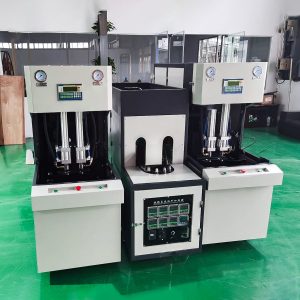
Both configurations share a similar water treatment, filling and packaging concept. The main difference is the PET bottle blowing section. The 1,000 BPH configuration normally uses one semi-automatic blow molding machine, while the 2,000 BPH configuration uses two semi-automatic blow molding machines connected to one heating oven.
The final equipment configuration can also be adjusted according to the water source, bottle size, factory space, operating schedule and future expansion plan.

Two Standard Semi-Automatic Configurations
For most small bottled water projects, the difference between a 1,000 BPH and 2,000 BPH semi-automatic line is not that every machine becomes larger.
Instead, the main capacity difference comes from the PET bottle blowing section.
The water treatment system, filling machine, labeling system, coding equipment and shrink packaging equipment can remain similar, while the bottle blowing capacity is increased by adding a second semi-automatic blow molding machine.
This makes the two configurations relatively straightforward to understand and allows investors to select a capacity according to their current market demand.
| Production Stage | Main Equipment | Main Function |
|---|---|---|
| Water Treatment | RO Water Treatment System | Treat raw water for bottled water production |
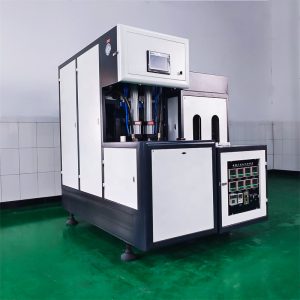
| Bottle Blowing | Semi-Automatic Blow Molding Machine | Convert PET preforms into bottles |
| Rinsing / Filling / Capping | TSGX 8-8-3 | Rinse bottles, fill water and cap bottles |
| Labeling | Semi-Automatic Sleeve Labeling System | Apply and shrink bottle labels |
| Coding | Laser or Inkjet Coding Machine | Print production and batch information |
| Packaging | Semi-Automatic Shrink Wrapping Machine | Pack finished bottles for handling and distribution |
1,000 BPH Semi-Automatic Bottled Water Line
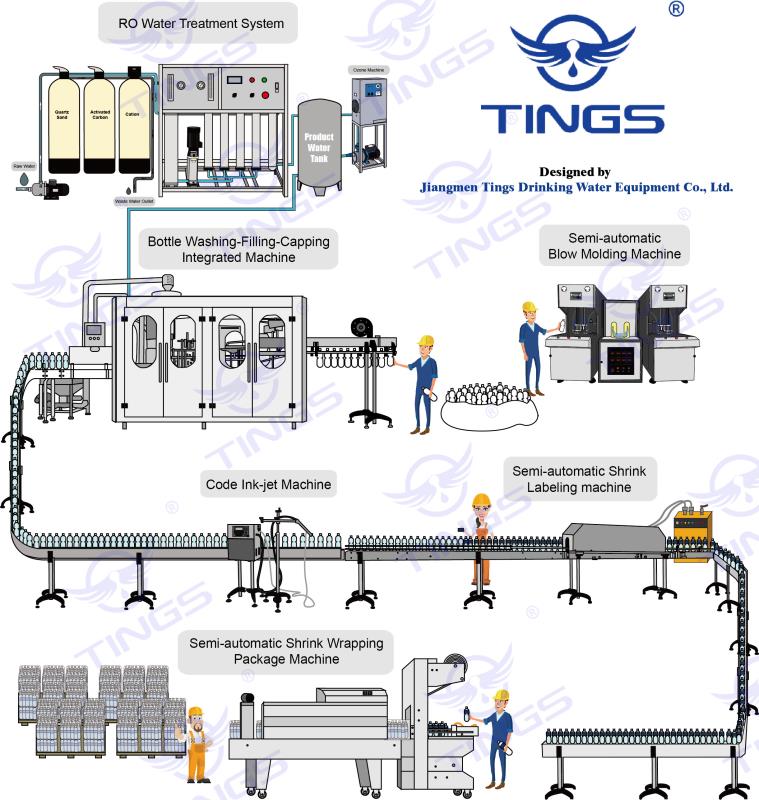
The 1,000 BPH configuration is designed around a 1-to-1 semi-automatic bottle blowing system.
It normally consists of:
- 1 heating oven
- 1 two-cavity semi-automatic blow molding machine
- Water treatment system
- TSGX 8-8-3 filling machine
- Semi-automatic shrink sleeve labeling system
- Laser or inkjet coding machine
- Semi-automatic shrink wrapping machine
- Conveyors and auxiliary equipment
The actual bottle blowing output can vary according to bottle design, preform heating conditions and operator efficiency. For this reason, TINGS normally uses approximately 1,000 BPH as the practical reference capacity
2,000 BPH Semi-Automatic Bottled Water Line
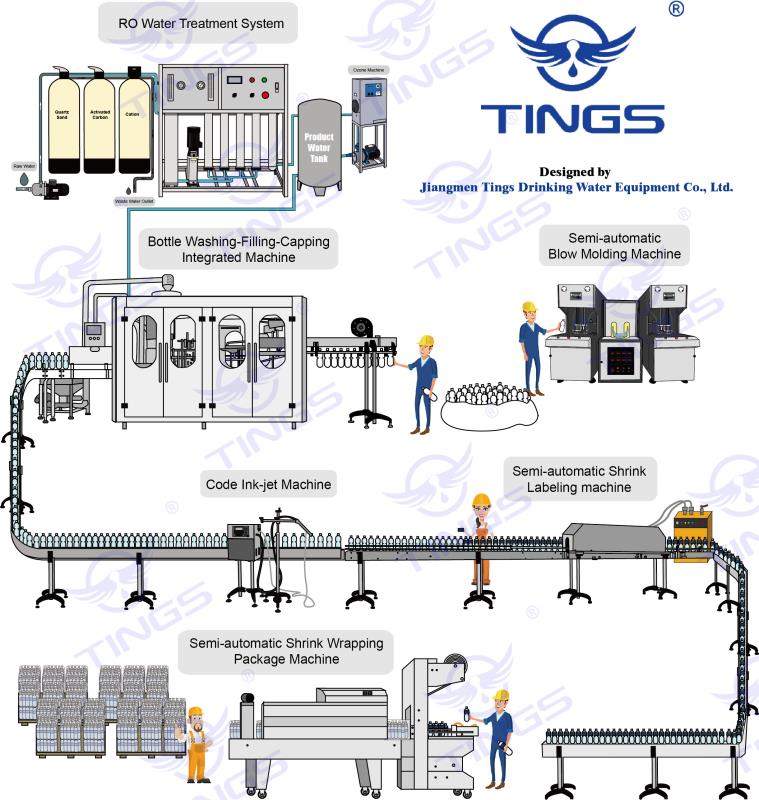
The 2,000 BPH configuration uses a 1-to-2 semi-automatic bottle blowing system.
It normally consists of:
- 1 heating oven
- 2 two-cavity semi-automatic blow molding machines
- Water treatment system
- TSGX 8-8-3 filling machine
- Semi-automatic shrink sleeve labeling system
- Laser or inkjet coding machine
- Semi-automatic shrink wrapping machine
- Conveyors and auxiliary equipment
The second blow molding machine increases the bottle production capacity
The practical reference capacity is approximately 2,000 bottles per hour
1,000 BPH vs. 2,000 BPH Configuration
| Configuration | 1,000 BPH Line | 2,000 BPH Line |
|---|---|---|
| Reference Output | Approximately 1,000 bottles/hour | Approximately 2,000 bottles/hour |
| Bottle Blowing System | 1-to-1 | 1-to-2 |
| Heating Oven | 1 | 1 |
| 主机 | 1 × 2-cavity | 2 × 2-cavity |
| Water Treatment | Typically 1–2 T/H, project dependent | Typically 1–2 T/H, project dependent |
| 灌装机 | TSGX 8-8-3 | TSGX 8-8-3 |
| Labeling | Semi-automatic sleeve labeling | Semi-automatic sleeve labeling |
| Coding | Laser or inkjet coding | Laser or inkjet coding |
| Packaging | Semi-automatic shrink wrapping | Semi-automatic shrink wrapping |
What Does 1-to-1 and 1-to-2 Bottle Blowing Mean?
The terms 1-to-1 and 1-to-2 describe the relationship between the bottle heating oven and the semi-automatic blow molding machines.
1-to-1 System
One heating oven supplies heated PET preforms to one two-cavity blow molding machine.
1-to-2 System
One heating oven supplies heated PET preforms to two two-cavity blow molding machines.
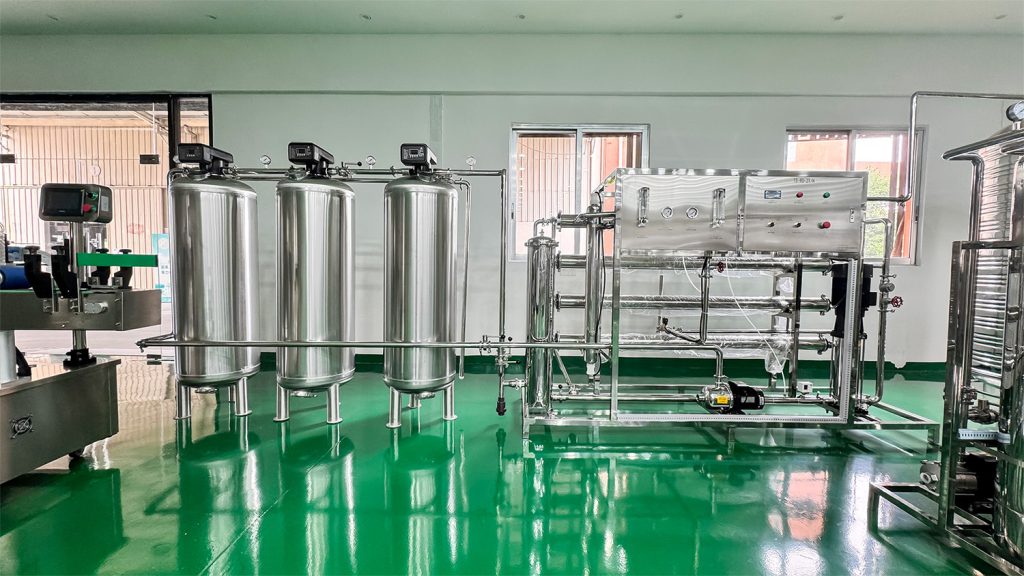
Water treatment is designed according to the characteristics of the raw water rather than simply according to the bottle production capacity.
For a small bottled water project, the treatment system may include stages such as raw water storage, quartz sand filtration, activated carbon filtration, softening or other pretreatment, precision filtration, reverse osmosis and final disinfection.
The exact process depends on the source water.
For example, borehole water, municipal water and surface water may require different treatment combinations. A water quality report is therefore valuable before the final treatment configuration is confirmed.
For many small projects, a 1–2 T/H water treatment system can be considered as a practical reference range. However, the final selection should also consider bottle size, daily operating hours, water recovery, cleaning requirements and future expansion.
TINGS can design the treatment process according to the customer’s raw water conditions rather than using one fixed configuration for every project.
https://www.jmtings.com/water-filling-machine/
After treated water and empty PET bottles are prepared, the two production streams meet at the filling section.
The TSGX 8-8-3 three-in-one filling machine can combine bottle rinsing, water filling and capping in one machine. This provides a compact solution for small bottled water production projects.
After filling and capping, the bottles can pass through:
Labeling → Coding → Shrink Wrapping
The labeling system can be selected according to the customer’s label material and packaging requirements. Coding equipment can be configured according to the required production information, such as date and batch coding.
The final packaging configuration can also be adjusted according to the customer’s preferred secondary packaging method.
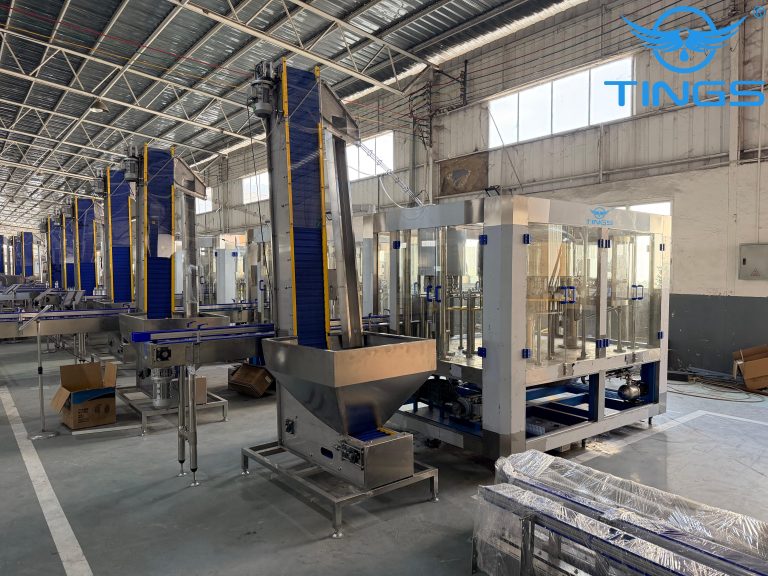
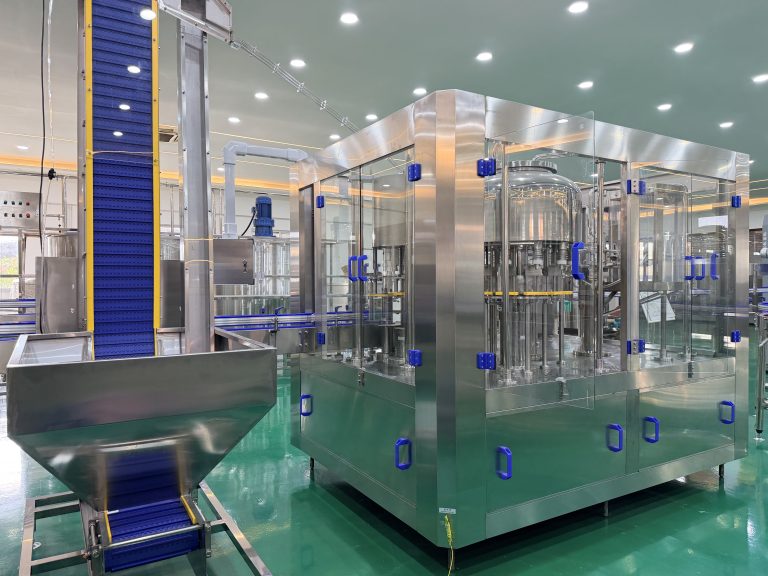
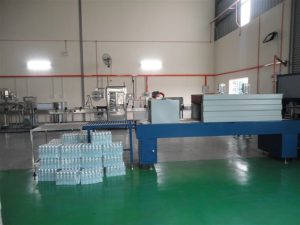
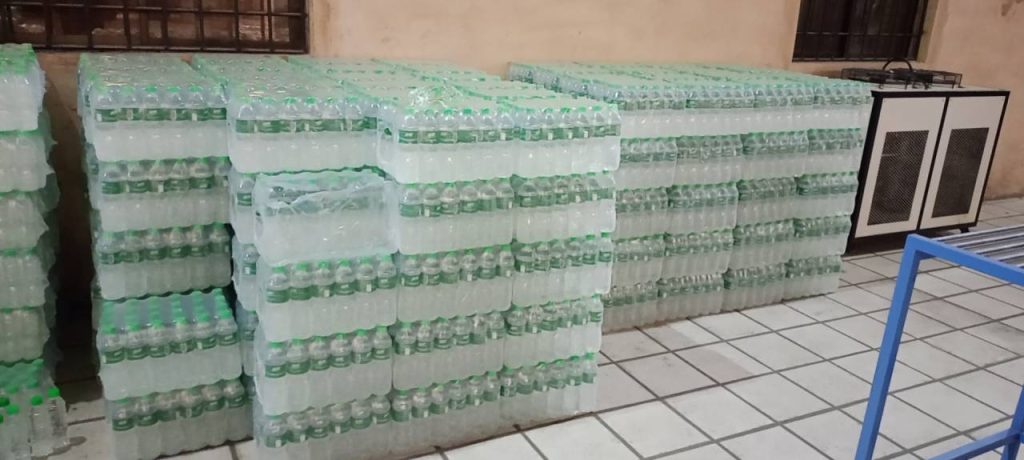
Photos of the customer operating the production line and manufacturing products
Why Is There No Standard 3,000 BPH Semi-Automatic Configuration?
The term 1,000–3,000 BPH semi-automatic production line is sometimes used as a broad market description.
In actual production, however, a semi-automatic line does not operate in exactly the same way as a fully automatic line.
Bottle blowing involves manual handling and operator intervention. The actual production rate can therefore vary according to preform loading, bottle handling, machine cycle, bottle design and operator efficiency.
For this reason, TINGS normally uses approximately 1,000 BPH and 2,000 BPH as practical reference points for its standard semi-automatic configurations.
If a customer needs a stable production target around 3,000 BPH, a fully automatic bottle blowing and filling configuration should be considered instead.
The objective is not simply to select the highest number shown on a machine specification sheet. The more important question is whether the complete production system can consistently meet the required production target under real operating conditions.
This is why TINGS separates the small semi-automatic solution from higher-capacity automatic production lines.
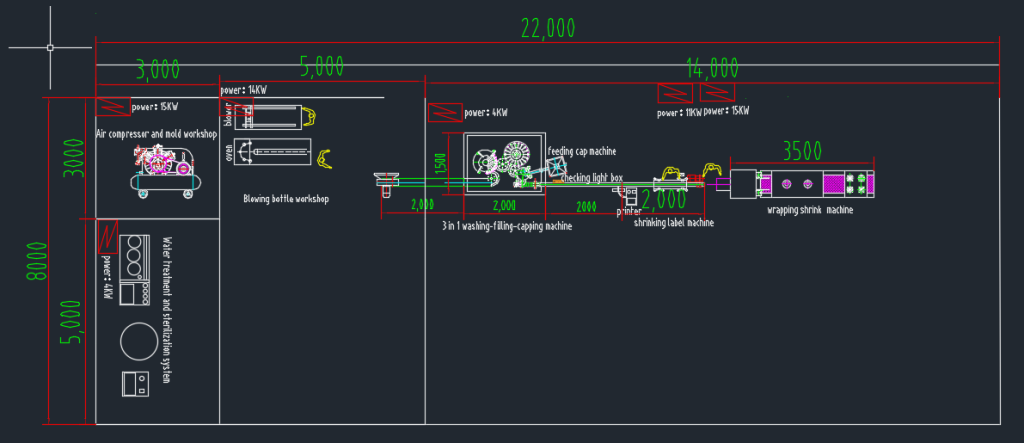
A small production line still needs to be planned as a complete production system.
The position of the water treatment equipment, bottle blowing section, filling machine, labeling equipment, packaging area, finished-product area and operator working space can affect the efficiency of the entire factory.
The factory layout should also consider:
- Raw water and product water flow
- PET preform storage
- Empty bottle movement
- Finished product movement
- Operator access
- Maintenance space
- Electrical and air supply
- Future equipment expansion
A compact factory does not necessarily mean that every machine should simply be placed as close together as possible.
The layout should leave enough space for operation, maintenance and future changes.
TINGS can prepare a factory layout according to the available building dimensions and the selected production line configuration.
Choosing the Right Production Line
A semi-automatic production line is a popular choice for investors entering the bottled water market, but it is not necessarily the right solution for every project.
The choice between semi-automatic and fully automatic production should be based on the overall business plan, including investment budget, local bottled water selling price, expected market demand, labor costs, government regulations and long-term production requirements.
For investors who want to control their initial investment or are entering a developing local market, a 1,000 or 2,000 BPH semi-automatic line can be a practical solution.
However, customers with sufficient investment capital and stronger expected demand may choose a fully automatic line from the beginning. Although the initial investment is higher, higher production capacity and lower labor requirements can make automation more economical over a longer operating period.
Therefore, there is no fixed rule that a new factory should start with a semi-automatic line. The right solution depends on the economics and development plan of each project.
TINGS can evaluate these factors together and recommend a production configuration based on the customer’s actual requirements.
A Real Example: From 2,000 BPH to 10,000 BPH in Ghana
A TINGS customer in Ghana provides a practical example of how a bottled water business can grow over time.
The customer previously purchased a 2,000 BPH semi-automatic production line from TINGS. As the business developed and production demand increased, the customer later invested in a 10,000 BPH fully automatic production line.
This case shows that a semi-automatic line can be an appropriate solution for one stage of a business, while a fully automatic line may become more suitable as production requirements grow.
At the same time, this does not mean every new investor should start with a semi-automatic line. Customers with sufficient capital, strong market demand or higher labor costs may choose a fully automatic production line from the beginning.
The appropriate solution depends on the customer’s investment capacity, market demand, labor costs and long-term production plan.
What TINGS Can Help You Plan
Choosing a bottled water production line is more than selecting a machine capacity.
Before preparing a final configuration, TINGS can help evaluate:
1. Water Source
The raw water source and available water quality information help determine the treatment process.
2. Bottle Size
Bottle volume, neck size, bottle design and preform specifications affect the bottle blowing and filling configuration.
3. Production Target
A target of approximately 1,000 BPH may lead to a different configuration from a project requiring approximately 2,000 BPH or more.
4. Factory Space
The available building dimensions affect the equipment arrangement, conveyor length and operator working areas.
5. Future Expansion
If the business is expected to grow, the first-stage factory layout and utilities can be considered with future equipment in mind.
This is why TINGS does not simply provide the same machine list to every customer.
The equipment can be standardized where practical, while the project configuration is adapted to the actual conditions of each factory.
Frequently Asked Questions
What is a small bottled water production line?
A small bottled water production line is a semi-automatic production system designed for investors and factories that require a relatively simple bottled water production setup. TINGS normally uses approximately 1,000 BPH and 2,000 BPH as practical reference configurations.
What is the difference between a 1,000 BPH and 2,000 BPH line?
The main difference is normally the PET bottle blowing section. A 1,000 BPH configuration uses one two-cavity semi-automatic blow molding machine, while a 2,000 BPH configuration uses two two-cavity machines connected to one heating oven.
Can the water treatment system be the same for both capacities?
Yes. The water treatment system does not necessarily need to double when production capacity doubles. The final treatment capacity depends on bottle size, operating hours, water consumption, recovery rate and the raw water conditions.
Can a semi-automatic line produce 3,000 BPH?
Actual output depends on equipment configuration and operator efficiency. TINGS does not normally treat 3,000 BPH as the standard reference point for a semi-automatic line. When stable production around 3,000 BPH is required, a fully automatic configuration should be evaluated.
Can I upgrade the production line later?
Yes. A factory can be planned so that additional bottle blowing, conveying, packaging or automatic equipment can be introduced as production demand increases. The upgrade path should be considered before the initial layout is finalized.
Do I need to produce my own PET bottles?
Not necessarily. A project can initially purchase ready-made PET bottles and introduce a bottle blowing machine at a later stage. The appropriate choice depends on local bottle availability, bottle cost, production volume and factory planning.
Plan Your Small Bottled Water Production Line
A successful bottled water project starts with the right configuration rather than simply choosing the largest nominal capacity.
For a new or expanding bottled water business, TINGS can help evaluate the water source, bottle size, production target, factory space, equipment configuration and future expansion plan before preparing the final solution.
Whether your target is approximately 1,000 BPH or 2,000 BPH, we can design the production line around your actual project conditions.
Tell us your water source, bottle size, target capacity and factory dimensions.
Get a customized bottled water production line proposal from TINGS.
| Your Situation | Recommended Reference | Reason |
|---|---|---|
| New business with lower initial demand | ≈ 1,000 BPH | Simpler bottle blowing configuration and lower initial equipment requirement |
| Growing local bottled water market | ≈ 2,000 BPH | Higher bottle production capacity while retaining a semi-automatic setup |
| Stable production target around 3,000 BPH | Fully automatic line | Better suited to higher and more consistent production requirements |
| Future expansion expected | Plan layout for the next stage | Allows future equipment and automation to be integrated more efficiently |
提供高质量的产品,超乎客户的期望。