

Why Most Bottled Water Factories in Africa Struggle in Their First Year
And three things that experienced investors do differently
Every year, more entrepreneurs across Africa invest in bottled water production. The business case is compelling — rising urban populations, unreliable municipal water supply, and growing consumer awareness about water quality all point in the same direction.
But behind the growth statistics, there’s a quieter story: a significant number of new water factories across the continent run into serious problems within their first twelve months of operation. Not because the market isn’t there. Not because the equipment doesn’t work. But because of decisions made before the first bottle was ever filled.
Three of them come up more consistently than any others.
Most bottled water factories in Africa rely on groundwater — borehole water drawn from wells drilled on-site or nearby. This is practical, cost-effective, and often the only viable source in areas where municipal supply is either unavailable or unreliable.
The problem is that borehole water varies enormously from one location to another. Hardness levels, mineral content, microbial load, and the presence of specific contaminants can differ significantly even between sites a few kilometers apart. And without a proper water quality test before system design, there’s no reliable basis for choosing the right treatment configuration.
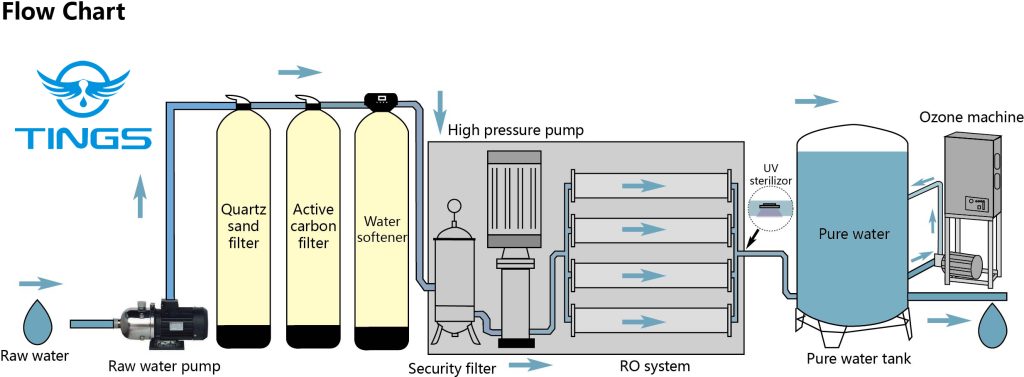
This matters more than it might seem. A water treatment system is not a generic product — it’s a configuration of components chosen to address the specific characteristics of a specific water source. Quartz sand filters, activated carbon filters, softeners, UV sterilizers, ozone systems, and RO membranes each serve a different purpose. The right combination depends entirely on what’s actually in the water.
What happens in practice is that some buyers, understandably focused on budget, accept proposals that strip out components to bring the price down. UV sterilizers get removed. Ozone systems get omitted. Disinfection capacity gets undersized. On paper, the system still looks like a water treatment plant. In operation, it may not be adequate.
The real-world consequence of this isn’t abstract. Among clients who have shared water quality test results before finalising their system design, a recurring finding has been the presence of E. coli — coliform bacteria that indicate faecal contamination. E. coli in borehole water is not unusual in many African regions, and it’s exactly the kind of contamination that requires properly specified disinfection to address.
A water quality test costs a fraction of what the production line costs. It takes a few days. And it’s the only reliable basis for designing a system that actually does what it needs to do.
For investors entering the bottled water business for the first time: get the water tested before you finalise the equipment list. Not after.
One of the questions that often surprises new clients is an early one: Has your factory space been confirmed?
It’s not small talk, and it’s not about gathering information for its own sake. It’s because factory layout has a direct and significant impact on how efficiently a production line actually runs — and on how many problems emerge after installation.
A complete bottled water line is a sequence of connected processes: water treatment, blow molding, rinsing, filling, capping, labeling, coding, packing. Each stage feeds into the next. The physical arrangement of that sequence inside a building determines how smoothly product moves through the line, where bottlenecks develop, how easily operators can monitor and intervene, and how efficiently maintenance can be carried out.
Get the layout wrong, and the consequences are operational rather than theoretical. A water inlet positioned too far from the treatment system creates unnecessary pipe runs and potential pressure loss. A drainage outlet in the wrong location means wastewater has nowhere to go without a workaround. Equipment arranged without accounting for operator movement creates congestion and slows production. Maintenance access that wasn’t planned for means that replacing a component requires dismantling other equipment first.
None of these are catastrophic in isolation. But together, they create a factory that runs at a fraction of its potential output — and generates frustration and unexpected cost from day one.
The standard practice for any serious project is to provide clients with a customised layout drawing based on the actual dimensions and configuration of their facility, after the order is confirmed. The goal is straightforward: to ensure that the production line can operate to its designed capacity under real conditions, not just in theory.
Factory layout is one of those areas where the right work done early costs nothing and saves a great deal. The wrong work — or no work — done early costs considerably more to fix later.
3. Miscalculating the Real Cost of Running the Line
Initial investment gets most of the attention. Running costs get most of the surprises.
This shows up in two ways that catch new investors off guard more than almost anything else: raw material cost and equipment maintenance cost.
Raw material cost: the bottle is not just packaging
The bottle that a consumer picks up in a store is the end product of a series of decisions made long before production started. Bottle design, preform weight, neck finish specification, wall thickness — each of these has a direct impact on material cost per unit, and that cost compounds at scale.
A useful example: smooth-sided bottles with no structural ribs can look elegant and premium. But without ribs to provide structural support, they require a heavier preform to maintain the same rigidity as a ribbed bottle. The difference in preform weight might seem small in isolation. At production volumes of hundreds of thousands of bottles per month, it translates directly into higher raw material spend, lower margins, and longer payback periods.
In a market like Ghana — where bottled water competition is intensifying, margins are tightening, and consumers are increasingly price-sensitive — raw material efficiency isn’t a minor consideration. It’s a competitive factor.
The right bottle design balances aesthetics with economics. A bottle can be visually distinctive and still be efficient to produce. Finding that balance before committing to molds is significantly easier — and cheaper — than changing direction after production has started.
Equipment running cost: what happens five years from now
The second dimension of running cost that investors frequently underestimate is the long-term maintenance and reliability of the equipment itself.
A production line is not a purchase — it’s an asset that needs to keep running, day after day, for years. The components that determine how reliably it does that, and how much it costs to maintain, matter as much as the initial configuration.
Equipment built with internationally recognised components — electrical systems, sensors, control units from established manufacturers — tends to be significantly easier to maintain than equipment built with lower-specification alternatives. Not because branded components never fail, but because when they do, replacements are available, suppliers can be identified, and lead times are manageable. The supply chain for well-known components is global. The supply chain for obscure alternatives often isn’t.
There’s also the question of structural components — the machined parts, cylinders, and plates that make up the mechanical core of a production line. Factories that operate their own CNC machining centres can reproduce these components to specification, even years after the original line was delivered. Factories that don’t have this capability are dependent on whatever stock exists — or on the client waiting while parts are sourced or fabricated externally.
The question worth asking before choosing a supplier isn’t just what does the line cost today. It’s what does it cost to keep this line running in year three, year five, year ten — and whether the supplier will still be able to provide what’s needed at that point.
These three factors — water quality, factory layout, and running cost — don’t appear in most equipment quotations. They’re not line items on a price list. But they shape the difference between a bottled water operation that reaches its potential and one that spends its first year managing problems that were, in hindsight, entirely avoidable.
We work with clients across Africa and beyond on complete bottled water and beverage production line solutions. If you’re in the planning stage and want to think through any of these areas before committing to equipment, we’re happy to talk.